


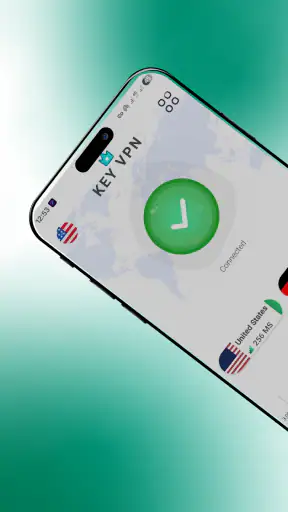


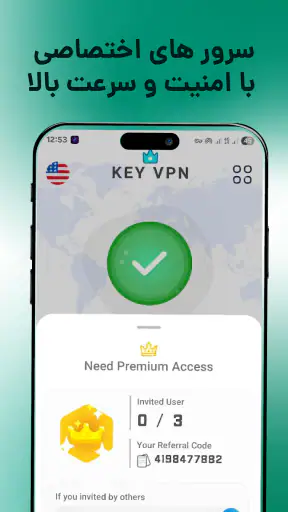
When a VPN is going to be used on a shared phone or tablet, the important question is not only whether it can protect a connection. It is also whether everyone using that device understands when it is active, what it changes, and when another person may need a normal connection instead. I tested Key VPN–Secure VPN with that everyday situation in mind, and I found it most useful as a simple communication app for safer browsing on public Wi-Fi rather than as a complicated privacy toolkit.
The app comes from Azadi vpn and is free to use. It is listed for Everyone, works with Android devices running version 7.0 or later, and its current version is 19. That makes it accessible for many older phones that are still shared around a household. Its average rating is 4.7 from around 220 thousand ratings, with more than 5 million installs, so it has clearly attracted a substantial audience. Those figures are encouraging, but I still think the practical experience matters more: a VPN has to be understandable enough that the person using it does not accidentally assume it solves every online safety problem.
How Key VPN fits a shared household connection
A realistic example is a family waiting in an airport, sitting in a café, or using Wi-Fi in a hotel. One person may need to check email, another may browse social media, and someone else may use the same Android tablet for a school-related task. In that setting, a VPN can add a useful layer of protection while the device is connected to a network that many strangers also use. Key VPN is aimed directly at that situation: safer browsing and data protection on public Wi-Fi.
What I like about this use case is that it does not require every member of the household to understand networking. One person can prepare the device, explain the basic routine, and leave the app available for the next user. The benefit is especially clear when the shared device travels frequently. Instead of treating every café or hotel network as familiar, the household can make VPN use part of its travel habit.
There is an important boundary, though. A VPN protects the connection path; it does not turn a shared device into a private device. It does not replace screen locks, careful app choices, updated software, or sensible account separation. If a child opens an account belonging to an adult, the VPN will not prevent that child from seeing information already available inside the account. Likewise, if a family member installs an untrusted app, the VPN is not a substitute for checking what that app does.
That distinction is easy to miss because the word “secure” can sound broader than the actual task. I would describe Key VPN as a connection-protection tool. I would not present it to relatives as a complete family safety system, parental-control service, password manager, or anonymous identity. That honest explanation helps prevent overconfidence, which is one of the biggest risks with any simple privacy app.
Preparing one device for several people
On a household device, I would first decide who is responsible for starting and stopping the connection. If several people can change settings without telling anyone else, the next user may not know whether the VPN is active. That can create confusion when a website behaves differently or when a service asks for an additional verification step.
I found it helpful to agree on a short routine: connect before joining unfamiliar public Wi-Fi, confirm that the connection is active, and disconnect when the device returns to a trusted home network if normal access is needed. The exact routine can be adapted to the family, but the key is consistency. A shared device benefits from a visible rule more than from a long technical explanation.
Key VPN is a better fit for households that want a straightforward tool than for people who want to fine-tune every part of a VPN connection. I would choose it for a parent who wants an easy travel precaution on an older Android phone, or for a shared tablet used in libraries and cafés. I would look elsewhere if the household needs detailed user profiles, advanced network rules, or separate policies for different family members. Nothing about the app’s basic positioning suggests that it is designed to manage those boundaries for you.
Setup boundaries matter more on a shared device
The first setup should be done by the person who understands the household’s accounts and devices. That person can explain what the app is for and make sure nobody mistakes it for an antivirus tool. On a shared phone, I would also avoid leaving sensitive accounts open simply because a VPN is enabled. The connection may be better protected, but the device can still expose information to the next person who picks it up.
Another practical point is to test the routine before travelling. Try opening the usual sites, checking messaging, and using any services that the family relies on. If something behaves unexpectedly, it is better to discover that at home than while rushing through an airport. A VPN can alter how some online services see a connection, so a shared household should know how to pause it when a particular service requires a direct or familiar network.
This is one of the app’s trade-offs. Its appeal comes from keeping the experience approachable, but an approachable interface can encourage people to skip the small checks that matter. I would not call that a flaw unique to Key VPN; it is a general issue with tools that make security feel effortless. My advice is to create a simple household agreement rather than relying on memory.
For an older Android device, compatibility is another practical advantage. Key VPN supports Android 7.0 and later, so it may work on a spare handset or family tablet that cannot run many newer apps. Still, older hardware can feel less responsive when a VPN is running, especially if several apps are already open. I would close unused apps before blaming the VPN for sluggish browsing, and I would compare normal browsing with VPN browsing in the same location rather than judging it from one brief test.
Coordinating accounts, browsing, and daily routines
Household coordination is where a basic VPN can either become useful or become a source of arguments. If one person connects it for travel and another person later finds that a streaming, banking, or work service behaves differently, the family needs a shared understanding of what happened. The simplest solution is to say out loud when the VPN is turned on, especially if the device is handed to someone else.
I also recommend separating “who uses the device” from “who controls the VPN.” Those do not have to be the same person. A teenager may use the tablet for homework, while an adult handles the initial setup. That arrangement is reasonable, but it should not be mistaken for monitoring. Key VPN can help protect traffic on an untrusted network; it does not provide a report of what another household member viewed, and I would not use it as a way to supervise private browsing.
For messaging, the app can be useful when a family member connects from a public hotspot and needs to communicate. The VPN layer may make that connection more comfortable to use, but the security of the messaging account still depends on the messaging service, the device lock, and the strength of the account credentials. I would encourage each person to use their own account where possible. Shared logins create more privacy problems than a VPN can solve.
A less obvious tip is to make a small note on the device’s travel checklist: “VPN on for unfamiliar Wi-Fi; check it before sensitive tasks; turn it off if a service needs the usual connection.” That note is more useful than telling someone simply to “always use the VPN.” It recognizes that household devices move between networks and that convenience sometimes requires a deliberate exception.
Age, trust, and what the Everyone label really means
The Everyone age classification makes Key VPN suitable for a broad audience, including families that share an Android device with younger users. I see that as an accessibility signal, not as proof that every online destination is appropriate for children. The VPN can protect a connection, but it does not decide which websites a child should visit or explain whether a message from a stranger is trustworthy.
That means trust and conversation remain central. If a child uses the app, I would explain that the VPN is like a protective layer around the internet connection, not a permission slip for unrestricted browsing. I would also make clear that the app does not make personal information safe to share everywhere. Names, school details, passwords, photographs, and location information still need careful handling.
For teenagers, the balance is slightly different. They may be capable of starting a VPN themselves, but they should still know that a connection tool does not hide activity from every service or erase the consequences of posting something publicly. I would rather teach them how to recognize public Wi-Fi risks and suspicious requests than suggest that Key VPN makes them invisible online.
Adults sharing a device should follow the same principle. A partner, roommate, or visiting relative deserves a clear boundary around accounts and browsing history. A VPN should not be presented as a way to inspect another person’s activity. In my view, the most responsible household use is transparent: everyone knows what the app does, when it is normally used, and who handles changes to the setup.
Where it stands beside usual alternatives
The usual alternatives in this category fall into two broad groups. Some are built into a broader security or browser ecosystem, while others focus on advanced VPN controls and detailed customization. Key VPN sits closer to the straightforward end. That makes it easier to recommend to someone who wants a free starting point for public Wi-Fi without learning a large set of technical options.
The compromise is depth. A specialist VPN may be a better choice for a user who needs extensive server selection, more control over connection behavior, or a mature desktop-and-mobile workflow. A security suite may be more suitable for a household that wants VPN protection alongside device scanning, account alerts, or other safety tools. Key VPN should be judged as a focused communication app, not as a replacement for an entire security subscription.
Its free price is a strong reason to try it, particularly for occasional travel or a backup phone. At the same time, free VPN users should be cautious about assuming that “free” means unlimited performance, identical behavior on every network, or the same level of support as a paid specialist service. I would test it with the household’s important everyday tasks before depending on it during a trip.
The app’s current version, 19, indicates that it is not merely a one-screen experiment, but a version number alone does not tell me how it will behave on every device. The sensible approach is to keep expectations practical: use it for the connection-protection role it presents, watch for compatibility issues, and avoid making it the sole safeguard for sensitive family information.
Who should use it and who should skip it
I would recommend Key VPN to someone who uses public Wi-Fi regularly, wants a free option, and prefers a simple app over a long list of technical controls. It is also a reasonable candidate for a shared Android tablet in a household that can agree on a clear connection routine. The broad age classification and support for Android 7.0 or later make it approachable for mixed-age homes and older devices.
I would be more cautious about recommending it to a business user handling confidential work, a privacy enthusiast who wants extensive control, or a family searching for built-in supervision features. Those users should compare more specialized products and examine their requirements carefully. Key VPN is not the right answer merely because the device has several users.
I would also skip it as a solution to problems it was not designed to solve. It will not repair a compromised account, prevent phishing, control a child’s screen time, or make an unsafe website safe. If the household’s main concern is account sharing, device access, or inappropriate content, the better answer is a combination of separate accounts, device-level settings, education, and trusted security practices.
My household verdict after using it
My overall impression is positive, with a clear condition: Key VPN works best when the household treats it as one small part of a sensible internet routine. Its free access, wide Android compatibility, and uncomplicated purpose make it easy to consider for travel, cafés, hotels, and other public networks. The strong average rating and large install base also suggest that many users find its basic proposition appealing.
What convinced me was not the idea of leaving a VPN switched on forever. It was the more controlled workflow of using it when the device moves onto an unfamiliar network, then checking whether the connection behaves normally before starting an important task. That approach is especially useful on a shared device because it combines protection with communication. Everyone knows what is happening instead of discovering it accidentally.
The main limitation is that the app cannot create trust between users or define account boundaries for a family. Those decisions still belong to the people using the device. If you want a free, accessible way to add protection while browsing on public Wi-Fi, I think Key VPN is worth trying. If you need advanced privacy controls, family management, or a complete security platform, I would choose a more specialized alternative.
In short, I would install it on a shared travel device, explain its purpose to every regular user, and keep the household routine simple. Use Key VPN as a connection safeguard, not as a substitute for judgment, separate accounts, or honest coordination. With that expectation, it earns a place among the practical tools I would recommend to a friend who wants a straightforward free VPN for everyday public Wi-Fi use.


